
Vedic Maths is one of the fastest Mental Maths system ever. Apart from the traditional methods used in classrooms, Vedic Maths in itself has a set of rules and principles which when mastered helps you perform simple mathematical operations (like addition, subtraction, multiplication and division) as well as complex arithmetics, algebra, geometry, calculus, conics and so on in an easier and faster way.
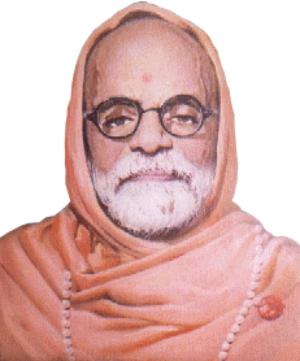
The concept of Vedic Maths was developed by Jagadguru Swami Bharathi Krishna Thirtha between A.D 1911 and 1918.
The term “Vedic” is derived from the Sanskrit word “Veda” which means knowledge.
It consists of 16 sutras or formulae and 13 sub-sutras or sub-formulae. By learning these sutras and sub-sutras and also practicing and mastering them, you can solve mathematical arithmetics faster than a calculator.
BEAUTY of Vedic Maths
Using the Vedic Maths concepts, any time-consuming or difficult calculations for competitive exams can be solved quickly as time is a critical factor for such exams.
Also, the complex mathematical topics like polynomial functions and quadratic sums encountered in higher classes in CBSE or any other board can be solved easily with the knowledge of Vedic Maths.
Below are some simple illustrations which depicts the beauty of Vedic Maths:
1. Subtract from 1000, 10000, 100000 and so on
Eg: Subtract 4627 from 10000
Subtract all digits from 9 except last digit
Step 1: 9 - 4 = 5
Step 2: 9 - 6 = 3
Step 3: 9 - 2 = 7
Step 3: Last digit, 10 - 7 = 3
Answer = 5373
2. Square of a Number ending with ‘5’
Eg: Find (75)2
Step 1: Add 1 to the first digit and multiply with the digit itself
        i.e: 7 * (7 + 1) = 7 * 8 = 56
Step 2: (5)2 = 25, which will be the last part of the answer
Step 3: Combining them, answer will be 5625
Answer = 5625
3. Multiplication by 5
Firstly, identify whether the number is even or odd
Even number
Eg: 5284 * 5
Step 1: Divide 5284 by 2 which is 2642
Step 2: Add 0 to the end
Answer = 26420
Odd Number
Eg: 7353 * 5
Step 1: Subtract 1 from the number
        i.e: 7353 - 1 = 7352
Step 2: Divide the result by 2
        i.e: 7352 / 2 = 3676
Step 3: Add 5 to the end
Answer = 36765
4. Multiplication by 11
Check whether the number is even or odd
Even number
Eg: 63 * 11
Assume that the answer is ABC
Step 1: A = the first digit of the number which is 6
Step 2: B = the sum of first and last digit which is 6 + 3 = 9
Step 3: C = the last digit of the number which is 3
Answer = 693
Interesting? Contact Us for more!
sutras in Vedic Maths
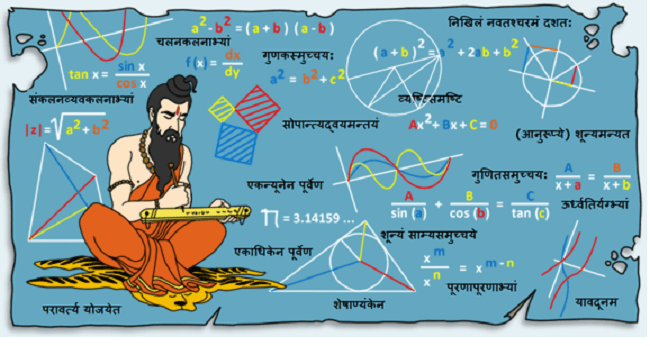
Vedic Maths is based on sixteen sutras, which were unravelled by Swami Bharati Krishna tirtha Ji Maharaj.
Below are the 16 sutras used in Vedic Maths:
| No. | Sutra Name | Meaning | Where to Use |
|---|---|---|---|
| 1 | Ekadhikena Purvena | By one more than the previous one | Squaring of a number ending with 5 |
| 2 | Nikhilam Navatashcaramam Dashatah | All from 9 and the last from 10 | Multiplication of numbers, which are near to base 10, 100, 1000 |
| 3 | Urdhva-Tiryagbyham | Vertically and crosswise | It is a general formula, applicable to all cases of multiplication of two large number |
| 4 | Paravartya Yojayet | Transpose and adjust | When divisor is greater than 10 |
| 5 | Shunyam Saamyasamuccaye | When the sum is the same that sum is zero | |
| 6 | Anurupyen Shunyamanyat | If one is in ratio, the other is zero | To find out the product of two number when both are near the common base like 40, 40, etc. (multiples of powers of 10). |
| 7 | Sankalana-Vyavakalanabhyam | By addition and by subtraction | It is used to solve simultaneous simple equations which have the co-efficient of the variables interchanged. |
| 8 | Puranapuranabyham | By the completion or Non-completion | Used to simplify or solve the algebra problems. |
| 9 | Chalana-Kalanabyham | Differences and Similarities | |
| 10 | Yaavadunam | Whatever the extent of its deficiency | Applicable to obtain sq. of a number close to bases of powers of 10 |
| 11 | Vyashtisamasthi | Part and Whole | Help in the factorisation of the quadratic equation of types |
| 12 | Shesanyankena Charamena | The remainders by the last digit | It is to express a fraction as a decimal to all its decimal places |
| 13 | Sopaantyadvayamantyam | The ultimate and twice the penultimate | |
| 14 | Ekanyunena Purvena | By one less than the previous one | This sutra is used in case of multiplication by 9, 99… |
| 15 | Gunitasamuchyah | The product of the sum is equal to the sum of the product | Used to verify the correctness of obtained answers in multiplications, divisions and factorizations. |
| 16 | Gunakasamuchyah | The factors of the sum are equal to the sum of the factors |
Want to know more? Check free tutorials on Vedic Maths here!
 Apna Saathi